
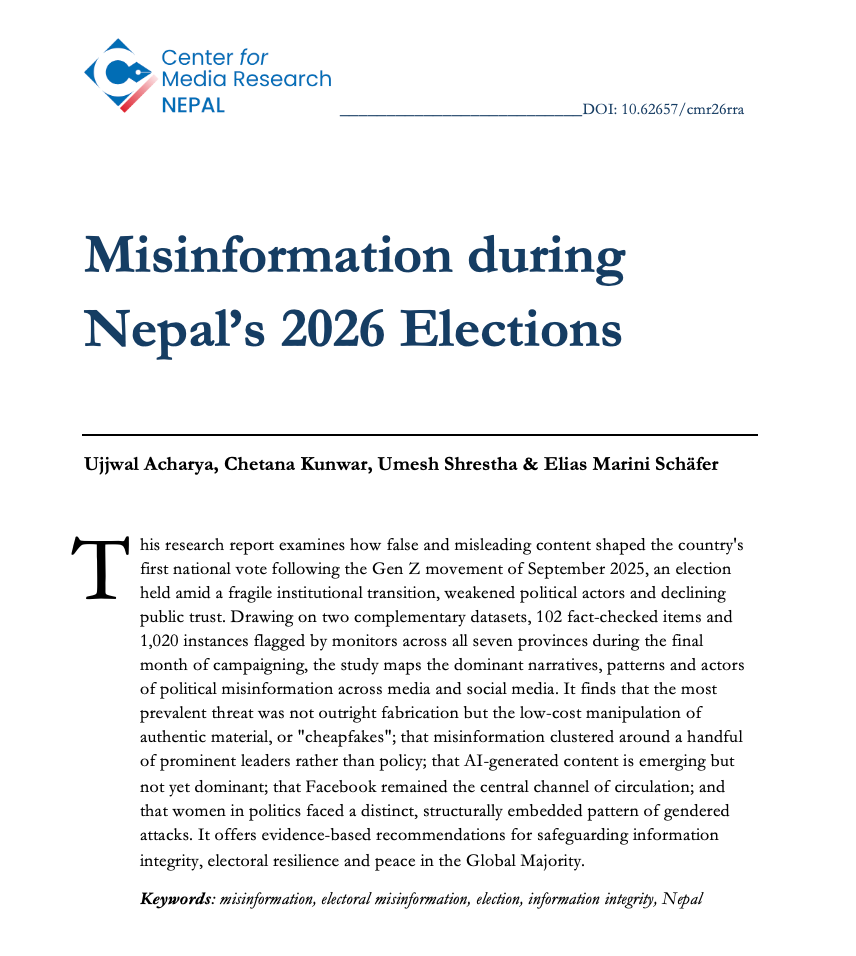
Misinformation During Nepal’s 2026 Elections
DOI: 10.62657/cmr26rra
Read | Download PDF
This research report examines how false and misleading content shaped the country’s first national vote following the Gen Z movement of September 2025, an election held amid a fragile institutional transition, weakened political actors and declining public trust.
Drawing on two complementary datasets, 102 fact-checked items and 1,020 instances flagged by monitors across all seven provinces during the final month of campaigning, the study maps the dominant narratives, patterns and actors of political misinformation across media and social media.
It finds that the most prevalent threat was not outright fabrication but the low-cost manipulation of authentic material, or “cheapfakes”; that misinformation clustered around a handful of prominent leaders rather than policy; that AI-generated content is emerging but not yet dominant; that Facebook remained the central channel of circulation; and that women in politics faced a distinct, structurally embedded pattern of gendered attacks.
It offers evidence-based recommendations for safeguarding information integrity, electoral resilience and peace in the Global Majority.
Authors: Ujjwal Acharya, Chetana Kunwar, Umesh Shrestha and Elias Marini Schäfer
Publisher: Ziviler Friedensdienst Deutsche Gesellschaft für Internationale Zusammenarbeit (GIZ) GmbH and Center for Media Research – Nepal
Edition: First
Publication Year: 2o26
Pages: 72